Old Christmas boxes rarely hold anything rare. Once in a while, though, a single ornament turns out to be a genuinely sought-after piece worth keeping on the tree rather than in…
Old Christmas boxes rarely hold anything rare. Once in a while, though, a single ornament turns out to be a genuinely sought-after piece worth keeping on the tree rather than in storage.
This guide covers eight categories of vintage Christmas decor worth a second look. Knowing what separates a common ornament from a coveted one changes how you treat the box in the attic.
Collectible holiday items run a wide range, from blown glass to cardboard villages, and a surprising number still show up in ordinary households...
1. German Kugel Ornaments
Kugels are the heavyweights of antique Christmas, made in Germany from roughly the 1840s through the early 1900s. A genuine one feels surprisingly dense for its size.
The tell is weight combined with a mercury-glass silvered lining and a decorative embossed brass cap. Brass here means plain stamped brass, not the thin modern caps.
Collectors chase grape clusters, pears, and teardrops above the plain rounds.
What to look for
Color drives price. Cobalt and amethyst examples command steep premiums over silver or gold. The heavy glass chips and cracks easily, and caps split, which is why an intact example is worth holding onto.
Tip
Set Kugels on a sturdy branch close to the trunk; their weight bends thin tips and the glass shatters on a hard floor.
2. Dresden Paper Figures
Dresden ornaments are embossed die-cut cardboard, finished with a thin layer of gold or silver foil over the pressed surface.
They came out of a German region spanning Dresden and Leipzig, produced in the decades between the 1880s and the early 1900s.
Three-dimensional versions were built by cementing two molded halves together to form a fish, a carriage, or an elephant. These are among the most coveted antique Christmas objects in existence.
How to spot an original
Crispness and complete gilding separate a good figure from a great one. A clean three-dimensional Dresden figure can fetch anywhere from the low hundreds up into the thousands.
They are scarce because the paper is fragile and the production window closed quickly once glass ornaments took over.
3. Shiny Brite Ornaments
Shiny Brite was started by Max Eckardt, a German immigrant. It rose to lead the American market once wartime bans shut off German imports, with machine-blown glass blanks supplied by Corning.
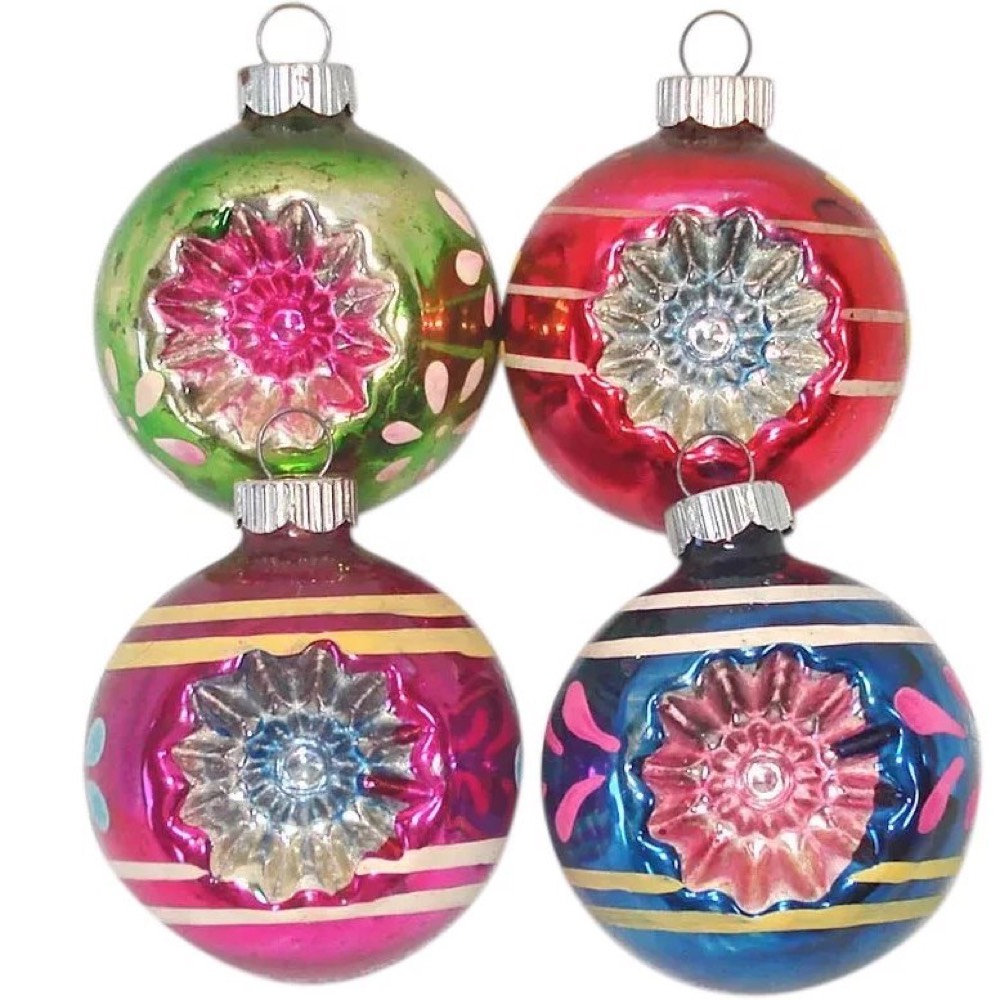
Look for a metal cap, usually carrying the stamped brand name, paired with striped or mica-dusted designs painted by hand.
Wartime versions traded the metal cap for a cardboard tab, and the silvering was dropped entirely under rationing.
What drives value
Three things set the price: silvering that is still intact, minimal paint loss, and the original divided box of cardboard. The box matters more than most people expect.
That original divided box can matter more to value than the ornaments inside it.
Keep ornaments in their original cardboard dividers. A reproduction box does not count, and loose storage rubs off the painted lacquer that collectors are paying for.
4. NOMA Bubble Lights
NOMA put bubble lights on American trees in 1946, and the design is credited to Carl Otis. Inside, a sealed vial of methylene chloride starts to boil and bubble as soon as the base lamp heats it.
A boxed strand that still lights and bubbles, dating to the late 1940s, is the version collectors actually want. The trouble is age. Old vials can leak or simply stop working, leaving a strand that lights but never bubbles.
Budget tip
Do not pay a premium for a strand you cannot test. A working, boxed set is the prize, and a partial strand with dead vials is just ordinary décor. I'd buy only what the seller will plug in.
5. Evergleam Aluminum Trees
The Aluminum Specialty Company of Manitowoc, Wisconsin, launched the Evergleam line in 1959. These trees were built to glow under a slowly turning color-wheel spotlight, not under strings of lights.
The reason was safety. Live bulbs on bare aluminum carried a real shock risk, so the color wheel kept electricity off the metal entirely. Manitowoc still runs a yearly festival honoring the trees it made.
Completeness is everything. The ones worth prizing still have their original branch sleeves, their box, and the matching color wheel. The hardest to find are the pink and blue-tinted trees along with the small tabletop models.
6. Putz Cardboard Houses
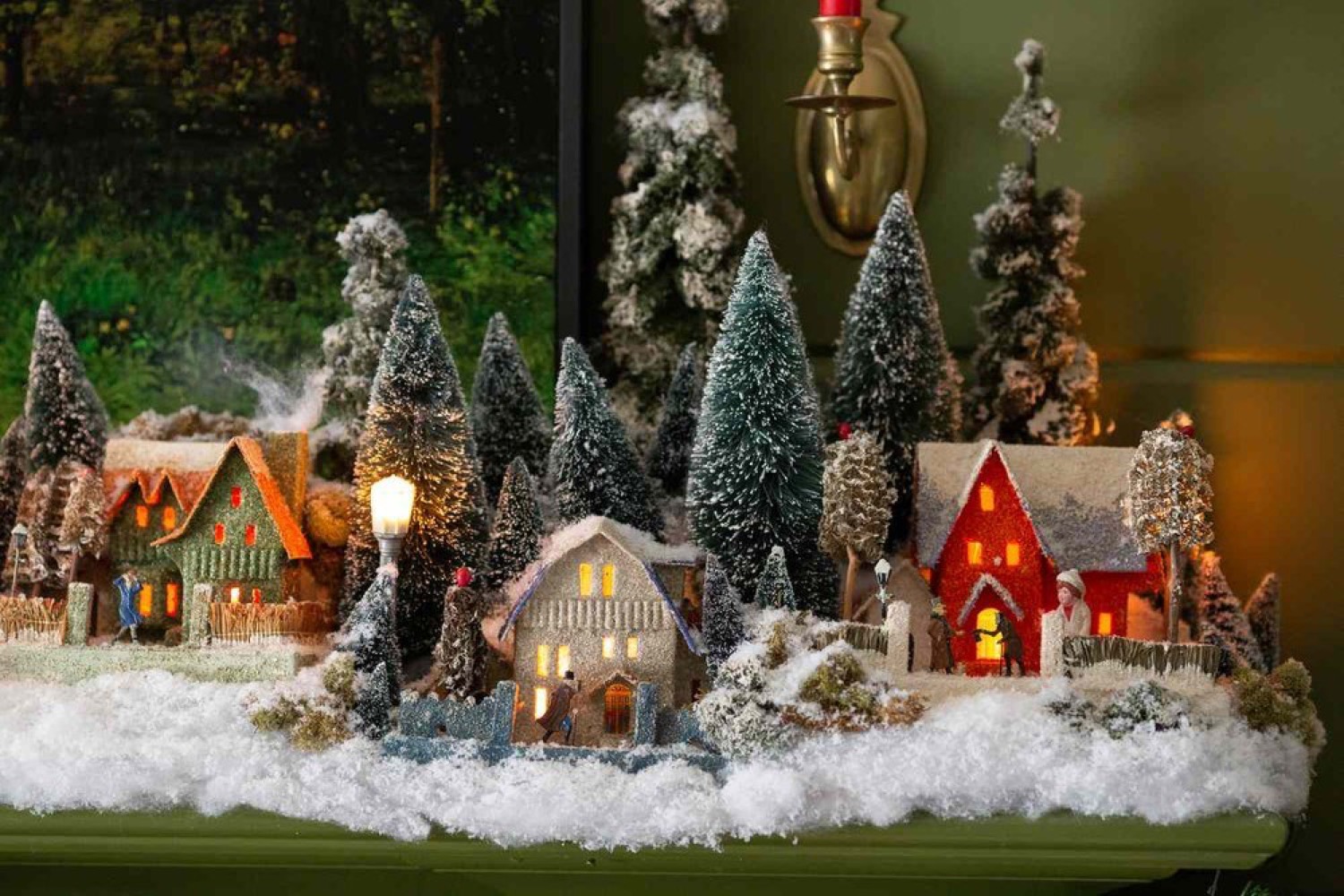
Putz houses are little cardboard buildings dusted in glitter, nearly all carrying a "Made in Japan" stamp. The name traces to the German verb putz, to decorate, and the houses were arranged beneath the tree as miniature villages.
Most have a cellophane window and a small patch of spun coconut fiber standing in for snow, with a hole punched in the back to fit a bulb.
Bethlehem and church models turn up constantly. The rare ones are lighthouses, filling stations, and sprawling multi-building sets.
How to spot a keeper
Condition reads fast on these. Collectors pay most for crisp, unfaded houses that keep their cellophane and still have the original bottle-brush trees glued down. A faded house with a missing tree is common stock.
7. Feather Trees and Bottle-Brush Greenery
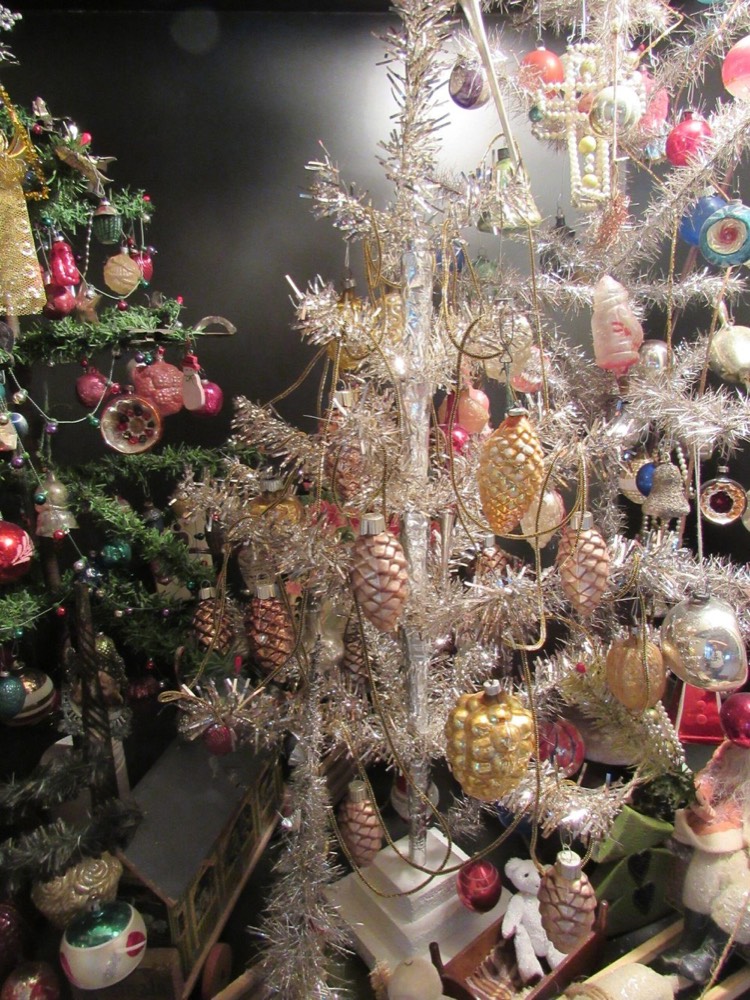
Feather trees came out of 19th-century Germany, made by wiring dyed goose feathers onto branches to imitate the thin limbs of a real evergreen. They are widely regarded as the earliest manufactured artificial Christmas trees.
The branches were spaced wide on purpose, giving each delicate glass ornament room to hang clear of the next. Look for a turned wooden base, and a tiny red composition berry capping the end of each branch.
Size and color set the value. Big trees and off-standard dye colors such as white or pink pull the most collector interest.
The same logic carries over to vintage bottle-brush trees, built from dyed bristles twisted onto a wire spine.
A dusting of mica snow or an off-green dye like red, pink, or blue lifts an ordinary tabletop tree above the common green ones.
8. Mercury Glass Bead Garland
This garland is strung from the same double-walled, silvered glass used to make mercury-glass ornaments, and it came largely from Japan and Czechoslovakia.
The beads run from plain rounds to figural shapes: lanterns, stars, and small baskets.
Long, unbroken runs and the figural stretches are the ones collectors want. A strand loses value fast once beads go missing or the wire turns to rust, so a long, intact strand with figural beads is the one to keep.
DIY tip
Store garland coiled loosely in tissue, never folded. The wire spine kinks and corrodes at sharp bends, and a broken strand loses most of its worth. Gentle handling preserves both the beads and the silvering.
Final Thoughts
Vintage Christmas decor runs the full range, from hand-blown German glass to mid-century aluminum and humble cardboard houses.
Condition and completeness carry most of these pieces, whether it is the original box, the matching color wheel, or the glued-in bottle-brush tree.
If you already hang any of these on your own tree, you are closer to the good stuff than you think. Look at the caps, the stamps, and the paper before next year's boxes go back in the attic.
The piece you have been treating as filler may deserve a spot at the front of the branch.